This Event Already Happened
- - -
High School STEM Scholar Recognition
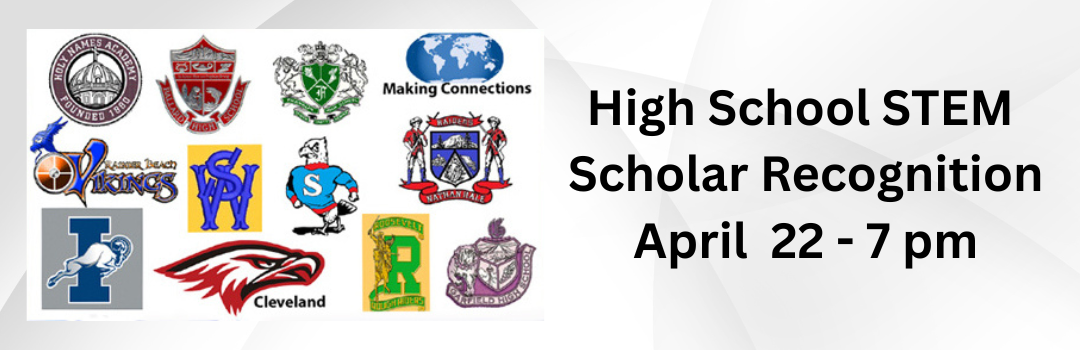
Wednesday, April 22, 2026
7:00PM - 8:30PM
Location: Center for Urban Horticulture
3501 NE 41st St Seattle, WA 98105
AAUW Seattle has been recognizing and honoring high school students for their talents in math, science and technology since 2001. We believe it’s critical to honor and encourage them to continue their studies in STEM fields. Every year in April we hold a reception and invite the awardees and their families to celebrate their considerable success. This year we will honor more than 30 11th graders who self-identify as women or were assigned female at birth and self identify as non-binary.
We work with a number of Seattle area public high schools and Making Connections at the University of Washington Women’s Center. All awardees are nominated by their teachers or counselors. Our members engage with the schools, facilitate the selections, and answer any questions.
We will have a panel of exciting and vibrant female scientists explaining their work and encouraging our students to ask them questions.
- Katherine Maslenikov is the Collections Manager of The Burke Museum’s Ichthyology Collection and a published scholar of Marine Science
- Dr. Caroline A.E. Strömberg, associate professor in Earth and Space Sciences at the University of Washington and the Curator of Paleobotany at the Burke Museum.
- Dr. Elena Austin uses emerging technologies to improve worker health and safety, particularly agricultural workers and their families in Washington State.
- Dr. Marissa Baker is an associate professor in the UW Department of Environmental & Occupational Health Sciences (DEOHS). Her research centers on occupational experiences of vulnerable or underrepresented groups.
More detailed bios follow:
Speaker: Katherine Maslenikov
Katherine Maslenikov is the Collections Manager of The Burke Museum’s Ichthyology Collection and a published scholar of Marine Science. The Ichthyology Collection maintains a large archival collection of more than 12 million preserved fish specimens from around the world, but primarily from the North Pacific Ocean and Bering Sea and from freshwater habitats of the Pacific Northwest. The Icthyology Collection Team’s primary mission is to promote teaching and research in the areas of ichthyology, fisheries biology, aquatic biology, biodiversity and conservation, and to provide a source of ichthyological information for the public.
Speaker: Dr. Caroline A.E. Strömberg
Dr. Strömberg is the Estella B. Leopold Professor of Biology and associate professor in Earth and Space Sciences at the University of Washington and the Curator of Paleobotany at the Burke Museum. Her primary research focuses on the deep time evolution and ecology of plants through the use of the fossil record and by comparison with modern analogues, more specifically how previous plant communities changed in response to climate change and how plant evolution affected animal evolution. There is a special place in her heart for the most awesome of all plants: grasses.
Speaker: Dr. Elena Austin
Dr. Austin received her Doctor of Science in environmental health from the Harvard T.H. Chan School of Public Health, with concentrations in exposure assessment and biostatistics. Her expertise areas and past work include multi-pollutant exposure metrics, geographic information systems, remote sensing, risk communication in farmworker communities, and the development and evaluation of data visualization tools. A number of her projects leverage novel applications of emerging technologies to improve worker health and safety, particularly in Washington state agricultural workers and their families.
Speaker: Dr. Marissa Baker
Dr. Marissa Baker is an associate professor in the UW Department of Environmental & Occupational Health Sciences (DEOHS). She also serves as deputy director of the Northwest Center for Occupational Health and Safety, housed at DEOHS. She is an affiliate faculty in the Harry Bridges Center for Labor Studies at UW. Dr. Baker’s research centers on occupational experiences of vulnerable or underrepresented groups. During the COVID-19 pandemic, she worked closely with a variety of worker organizations, government and industry partners to characterize physical and mental health outcomes experienced by workers, characterize their risk perceptions and needs, and propose and evaluate interventions for safe work.