Latina Struggles—Professional & Personal Experiences with Dr. Maria Chavez

Wednesday, April 1, 2026
9:30AM - 12:00PM
Location: Watertown Hotel
4242 Roosevelt Way NE
Seattle, WA 98105
Dr. Maria Chávez is a Professor of Political Science at Pacific Lutheran University. We are delighted to have her speak on gender equity and Latina women. This is also our branch annual meeting with election of officers.
Maria Chávez (she/her) is a professor of political science at Pacific Lutheran University specializing in American government, public policy, and race and politics. As a first-generation college graduate herself, her work centers on the progress and barriers of Latinas/Latinos in the United States. She was awarded the American Political Science Association’s Best Book in Latino Politics twice — first for Everyday Injustice (2011), and most recently for Latino Professionals in America (2019).
Program is Free. Reservations Required - .(JavaScript must be enabled to view this email address)
Parking and Transportation: The Watertown Hotel, 4242 Roosevelt Way NE, is in the University District close to public transportation including light rail.
There is a parking garage beneath the hotel that is easy to enter from the left lane of Roosevelt Ave (one-way street going south). To open the parking garage gate, use the call button to tell the hotel operator you are there for the AAUW meeting. There is a $5 fee for parking, pay at the desk after you arrive. Carpooling is suggested.
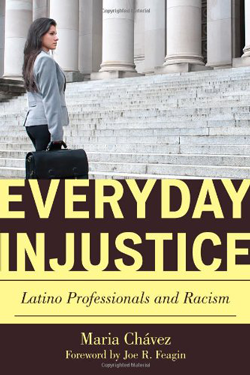
Following is an abstract of Dr. Chávez’ book Everyday Injustice prepared by our member Marianne North:
Abstract, Chapter 4 “Challenges for Latina Women” from
Everyday Injustices, by Maria Chávez, Ph.D
The challenges Latina women face in professions such as law are outlined in this chapter of Everyday Injustices published in 2011 by Dr. Maria Chávez, now professor of political science at Pacific Lutheran University in Washington State. Dr. Chavez will speak on this topic at the AAUW Seattle Annual Meeting May 20, 2023, at 10:00 AM in the Watertown Hotel in Seattle.
Through interviews, the research of other groups, and her own research, Dr. Chavez found Latinas in the professions face a complicated set of challenges in completing their education and maintaining the high levels of achievement they often demonstrate in their careers. They often grow up in poverty and/or as first generation Americans whose parents and other family members may have little experience with the American higher education system. As girls and women, they are expected to help with family care and chores, and they may be expected to give priority over their studies to the family.
After attaining a professional degree, the Latina women encounter a unique set of challenges on the job. The author provides a quote from one respondent in a study:
“The intersection of race, gender, and CLASS is rarely discussed…Almost without exception, white colleagues and colleagues of color come from middle-class or elite families—-and they cannot begin to understand the ways in which our lives are radically different. Sadly, this may lead to condescension towards us rather than respect for the extraordinary things we’ve overcome to get to where we are.”
The author quotes Ron Ward, past president of the Washington State Bar Association, as saying, “We’ve still a long way to go,” regarding diversity in the legal profession. While the number of women in law has increased from 14% in 1970 to 40% in the 2010’s, and to nearly 50% in large law firms, Ward pointed out that 100% of women of color have left their first law firm or law practice altogether at the end of their initial eight years of practice as shown in the American Bar Association’s Miles to Go report. A Latina respondent in this study commented on the racial and gender discrimination she experienced in college and in law school:
“…the micro-aggressions…the little digs, the snubs, the lack of respect that someone in a similar position would be accorded…the difficulty of getting through undergraduate and law school surrounded by people who are extraordinarily privileged but they have never used that privilege to educate themselves about other cultures …and just saying the most God-awful and thoughtless things over and over—and just what that does to you, you either have to be constantly jumping—which exhausts you—or pick your battles, which means you have to swallow some things…even though you are furious. But what that does to your morale and mental state.”
Lack of knowledge on how to get into law school was documented in a study: 40.5% of Latinas indicated it posed somewhat of an obstacle or a substantial obstacle compared to 17.6% of the women in the comparison group and 10.9% of the males in the comparison group. Family obligations also proved an impediment based on gender: 38.1% of the Latina lawyers indicated family obligations posed somewhat of, or a significant, obstacle to obtaining a higher education compared to 28.8% of women in the comparison group
In spite of these obstacles the majority of Latina lawyers surveyed indicated a high degree of satisfaction with their profession and with their decision to go to law school.